Friday, March 27, 2015

Periodontal Probing

A periodontal examination and probing are used to assess the health of your gums and supporting bone level. This is done by your dentist or dental hygienist at every routine cleaning appointment. The probing examination helps to diagnose Gingivitis or Periodontal Disease, and is only a benefit to you! Your gums may be "poked" every 6 months, but the benefit far outweighs the consequence! 


Healthy Periodontal Evaluation

Periodontal Sulcus Measurement


The space measured is called the sulcus or periodontal pocket (if unhealthy). It is the spot where the gum attaches to the tooth. This space is where plaque and food can accumulate and where flossing occurs. A healthy measurement is 1-3mm deep. A measurement of 4-5mm indicates that some bone loss has occurred, and a measurement of 6mm+ indicates moderate to severe periodontal disease. Healthy gums cling to the tooth, where unhealthy gums tend to swell and pull away from the tooth.


Probing measurements are not the only assessment taken. Bleeding, recession, furcation involvement and mobility are also measured. If bleeding occurs during the probing assessment, this does not mean your dentist or dental hygienist are jabbing your gums. Bleeding indicates infection and stipulates the gums have bacteria present that need to be eliminated. On teeth where multiple roots exist, a furcation (between the roots) is present. If this area is shown, a recording is documented. All of these assessments help to diagnose and determine the severity of Gingivitis or Periodontal Disease. 

Bleeding during Probing

Recession

Furcation Involvement


Repeating these measurements helps to track the progress of the treatment. You may need a common treatment done called Scaling and Root Planing also known as a deep cleaning. The measurements are taken prior to the treatment and then again weeks to months following. If you are heeding your Dental Hygienists recommendations, these measurements can improve depending on the amount of bone that has been lost. 

The periodontal assessment is a very important examination that every Dentist or Dental Hygienist should be performing! It is only to your benefit! Help us help you improve your oral health!

-A Healthy Body Starts With a Healthy Smile-


Sunday, March 15, 2015

Dental Sealants

What are dental sealants, who should get them and how long do they last? 

These are some really great questions! Sealants are a thin plastic coating that is painted onto the chewing surfaces of the teeth (usually the back teeth) to prevent tooth decay. Molars and premolars have several grooves, ridges, pits and fissures that plaque and food can get trapped in. Thorough brushing can help reduce this plaque from sticking but toothbrush bristles do not reach all the way down into these grooves.


Sealants are very easy to apply and no injections or numbing is needed! The sealant is placed directly onto the tooth surface which then bonds to the enamel and hardens. The sealant acts as a barrier, protecting the enamel from acid wear and decay. As long as the sealant remains intact, the tooth surface will be protected. 

Anyone can have dental sealants placed. However, sealants are more commonly placed on children. As soon as the first permanent tooth erupts, parents should be requesting that a sealant be placed to protect the tooth. Sealants are only needed on teeth with deep grooves and pits. Your dentist will perform a thorough exam to diagnose which teeth will benefit from a dental sealant. 


Dental sealants need to be checked at every dental cleaning visit for chips or cracks. If a dental sealant is chipped, bacteria can accumulate around the edge of the sealant and cause decay. During your dental exam, you may notice your dentist poking at the chewing surface of your teeth. He is checking the grooves and pits for any spot that may be sticky. This will indicate that a cavity has started and needs to be addressed. 


Ask your dentist if dental sealants will benefit you! Always remember to have your teeth professionally cleaned as directed by your dentist or dental hygienist. The sooner a cavity is detected, the quicker and cheaper this tooth can be fixed!

-A Healthy Body Starts With a Healthy Smile-


Saturday, February 28, 2015

Baby Bottle Mouth


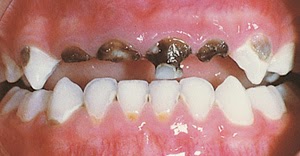
Baby Bottle Mouth, also known as Baby Bottle Tooth Decay or Early Childhood Caries, is caused by the frequent and long-term exposure to your child's teeth to liquids containing sugar. Among these sugary drinks is.... milk. Yes, you heard right, milk! Many mothers do not know how to care for their child's teeth. So, let's review!

Who Gets Baby Bottle Tooth Decay?

Every child is susceptible to tooth decay. You know that clear saliva drooling from your babies mouth from time to time? This is the culprit, and the problem comes at the wonderful time your baby falls asleep. Swallowing decreases and saliva production plummets. Any liquid left in your child's mouth during sleep continues to wear down the enamel. However, bedtime is not the only time this can occur. If you allow your child to run around during the day with a bottle in their mouth, this increases the exposure times to those sugars. 

What are the Symptoms of Baby Bottle Tooth Decay?

This decay strikes the most visible portion of the front teeth. This can be clearly seen if a mother is actively looking inside her child's mouth. However, the front teeth are not the only teeth affected. Any erupted tooth can be suspect to decay. This decay, if severe enough, can cause the child pain and if the decay continues further, can affect the permanent tooth sitting patiently below. 

What Does the Decay Look Like?

In the beginning stages, decay may be un-noticeable. Until the enamel is completely broken down decay is hard to detect. However, it is still there. Check daily for any white, yellow or brown spots on your child's teeth. These colors indicate how severe the decay may be. 


Healthy Smile

Beginning Stages of Decay

Mild Decay

Moderate Decay

Severe Decay

How Can Baby Bottle Tooth Decay be Prevented?

Tooth decay can be prevented by reducing the exposure times to liquids containing sugar. Do not put your child to sleep with a bottle of juice or milk! Moving the feeding time forward by even 15 minutes so that your child can finish eating prior to bedtime can significantly protect the teeth. Many children are only put to sleep by the comfort of sucking. Rather than a bottle, a pacifier is a better option. A bottle of water is also a good option. If your baby is in the habit of juice at bedtime, try diluting the juice with water. 

The American Academy of Pediatrics wisely recommends that parents only give bottles during feedings and not allow their children to carry a bottle between meals. 

I also commend the American Academy of Pediatric Dentistry’s recommendation to start cleaning your child's teeth at least once a day as soon as the teeth come in. Allowing your child to chew or suck on a tooth brush from an early age will help in the process of brushing.


Remember, follow a dental routine! We recommend seeing your children twice a year from the age of 2, if not before. This allows us to catch early decay before extractions or root canals are needed. Start healthy habits while your children are young. If you love to brush your teeth, so will they!

-A Healthy Body Starts With a Healthy Smile-


Saturday, February 21, 2015

Dental Implants.. are you a candidate?

If you are self-conscious because you have missing teeth, wear dentures that are uncomfortable or can't eat the foods you love, a dental implant may be the right option for you. Dental implants are the perfect long-term option to restore your beautiful smile! Yes, dental implants can be quite the investment, but an investment you won't regret!


Dental implants are made up of titanium and are well compatible with the human body. They are posts that are surgically placed in the upper or lower jaw to restore form and function to the mouth. It is important that you are in good health as some habits or diseases can affect whether the implant will fail. For example, uncontrolled diabetes, smoking, alcoholism, cancer or radiation to the jaw, or uncontrolled periodontal disease. It is also important to let your dentist or oral surgeon know all medical conditions, medications or herbal supplements that you are taking prior to implant placement. 


Implant placement usually requires 2-3 steps and several months for completion. 


  • First, the dentist surgically places the titanium implant into the jawbone. Sometimes, a bone graft is needed and placed around the implant to help fill in the missing bone. 
  • Second, osseonintegration needs to occur and usually will take 2-4 months. What makes an implant so strong is that the jawbone actually grows around and holds it in place. The implant is integrated with the jawbone and becomes one.
  • Finally, the abutment and crown are placed on the implant to restore the complete restoration. The abutment is a device that joins the crown to the implant itself. Once the crown is placed, the full dental implant should be indistinguishable from your natural teeth.

If you are missing several teeth, an implant bridge may be your perfect option. This requires placing two or more implants to replace three or more teeth. 


The procedure is the same as replacing a single tooth, and a bridge is joined onto the abutments. The teeth have been replaced and bone loss has been halted. 


If you are missing all teeth on the upper or lower jawbone, an implant supported denture can be made. Why is this a better option than just a denture? The denture itself is joined onto the implants and can be secured or made to be removable. This option makes chewing, eating and talking much more normal.


Dental implants differ from natural teeth in several ways. There are also a few perks of a dental implant that makes it the best long-term option! Teeth are susceptible to decay as well as the need for a root canal. Dental implants are metal and do not decay or need root canals. The surrounding gums of natural teeth are susceptible to Periodontal Disease while dental implants are susceptible to Peri-implantitis; an inflammatory response to bacteria. 


If you are interested in dental implants, it is important that you get a full oral evaluation by your dentist. Implants do require good oral health much like natural teeth. Your dentist will carefully monitor your implants for mobility and that the implant crown, bridgework or dentures are functioning properly. 

Dr. Liddiard is capable, confident and licensed in placing any dental implant you are in need of. A free consultation is waiting for you! Visit our website for more information!

-A Healthy Body Starts With a Healthy Smile- 


Saturday, February 7, 2015

Do I Really Need a Root Canal??

Do I really need a root canal? Sounds painful! What is it all about?

First, let's review the basic anatomy of a tooth..


Teeth are "tough" on the outside. The outer enamel layer is to thank for this! Enamel is considered the hardest substance in the human body. With the constant chewing and daily acid attacks, this layer protects our teeth from wear and erosion. Inside the tooth is a soft core called a nerve chamber. The pulp chamber is made up of nerves and blood vessels that feed the tooth. Essentially, our teeth are considered a living thing, and, as with all living things, our teeth can "die". A tooth's nerve and pulp can become inflamed, irritated or infected due to deep decay, large fillings, a crack or chip in the tooth or trauma to the tooth. Tooth trauma includes: grinding, clenching or facial trauma. Sometimes, a tooth can die for no apparent reason. This is usually a chronic process that occurs over several years.

In most cases, the patient is faced with two options; a root canal therapy or extraction. A root canal is considered a therapy and not a treatment and usually, this is the last ditch effort to save the tooth. A tooth treated with a root canal can last several years. However, sometimes a tooth can become re-infected and extraction is needed. If extraction is needed, an implant can be placed to restore form and function to the mouth. 

Upon diagnosing the need for a root canal, a radiograph (x-ray) is taken. The Dentist or Endodontist is looking for several things including; an abscess, inflamed periodontal ligament, deep decay, or a crack/fracture. 

Abscess formed at apex of root

Deep decay


Inflamed Periodontal Ligament

What are the signs that a Root Canal is needed?
  • Severe tooth pain when chewing or pressure is applied
  • Prolonged sensitivity/pain to hot or cold, even when the source is removed
  • Discoloration or darkening of the tooth
  • A persistent, recurring "pimple" near the pained tooth
  • A dull ache that lasts several minutes to hours, or pain the persists throughout the night
  • Swelling and tenderness in the nearby gums
  • Facial swelling in the affected area

What does the Root Canal procedure consist of?


During the root canal, the diseased pulp is removed, cleaned and then sealed. The final step involves further restoration of the tooth. Because a tooth that needed a root canal is often times one that had a large filling or deep decay, a crown needs to be placed on the tooth to protect it, prevent it from breaking, and restore it to full function. The first few days after the root canal, the tooth may feel sensitive due to inflammation, especially if there was pain or infection before the procedure. Over-the-counter medications like Tylenol or Ibuprofen can help soothe any pain. Most patients can return to their normal activities the next day, and state that the root canal itself was no more painful than getting a cavity filled. 

Saving your natural tooth is always the best option. Our dental staff can help discuss your options; we are always here to help you make the best educated decision for yourself!

-A Healthy Body Starts With a Healthy Smile-


Saturday, January 24, 2015

Teeth Whitening.. Do's & Don'ts

The initial first step, when deciding to whiten your teeth, must be a dental examination with x-ray pictures taken. There are several causes of tooth discoloration- abscessed teeth, decay, Turner's Tooth, Tetracycline stain, to name a few- for which bleaching will not solve. Also, exposed tooth roots will not bleach and your results will not be ideal; cosmetic treatment options other than whitening would be better solutions for this problem. Your Dentist can determine the proper treatment and decide if bleaching is right for you. 

Can Whitening Damage My Teeth?

Proper bleaching with low solutions of peroxide have been determined safe to use and will not harm the enamel. There are blogs or Pinterest ideas that suggest using a lemon juice and baking soda paste on your teeth to remove stain. Does this work? Possibly. Is it harmful? Yes. The acidity level (on the pH scale) of lemon juice is 2. Battery acid or sulfuric acid (on the pH scale) are 0 and 1. Anything with that amount of acidity is bound to destroy your enamel, and remember, once its gone... its gone. The most common and thoroughly researched bleaching products are 10% carbamide peroxide (used at home in trays), and 35% hydrogen peroxide (used in office). Carbamide peroxide is a mixture of hydrogen peroxide and urea, and has a longer wear time. This product does not break down as quickly as hydrogen peroxide and also helps lessen the acidity level where the enamel is not affected. Hydrogen peroxide may contain stronger concentrations but only stays active up to an hour. With a high acidic level, this product should not be left on the teeth for extensive lengths of time. 

What About Tooth Sensitivity?

If you already suffer from tooth sensitivity... beware! Most people complain of sensitivity and therefore do not continue bleaching. However, there are things you can do to prevent or lessen the amount of sensitivity that will occur. Potassium Nitrate is the active ingredient used in sensitivity toothpastes, including Sensodyne. Potassium Nitrate works by shielding nerve endings and blocking the pain impulse to the brain. Studies suggest by using a sensitivity toothpaste 2 WEEKS prior to bleaching, as well as after, may lessen the sensitivity up to 90%.  In-office fluoride treatments can also help decrease sensitivity by blocking the nerve endings. Finding a toothpaste that has fluoride and potassium nitrate is ideal. Through experience, our Dental Hygienist has found, that patients find relief by placing a sensitivity toothpaste into their trays and wearing them up to 30 minutes prior to bleaching. Her patients also receive a 5% sodium fluoride treatment at every 6 month hygiene appointment. 


Do All Teeth Whiten?

Every persons whitening capabilities are different and each set of teeth have their own whitening capacity at which point they will no longer whiten. Just like everyone has their own shade of skin, everyone has their own shade of teeth. Peroxide goes through the enamel, through the dentin and changes the genetic color. Often times, someones teeth may contain stain; making them look less white. This stain can be removed by swishing with an over-the-counter hydrogen peroxide or brushing with a baking soda paste. This process does not penetrate the tooth but removes any surface enamel stain, improving the whiteness of the teeth. As stated before, some teeth are discolored for different reasons. Tetracycline stain is an internal stain that cannot be removed and possibly will not whiten. Again, your dentist can determine if whitening is right for you. 


Tetracycline Stain


Whitening Procedures..

The most common tooth whitening procedures are, an in-office treatment and at-home whitening trays. In-office treatments are generally expensive but give a quicker result than bleaching at home. You can expect a 2-4 shade difference with this procedure. At-home whitening trays may produce the same result as an in-office treatment but with a few weeks time. At Cornerstone Dental Care, we use an in-office bleaching system called Boost. A 40% hydrogen peroxide gel is placed on the teeth for 2-3, 20 minute applications. A barrier is placed around the gums to prevent them from burning during the treatment. We have seen great results with this in-office whitening treatment! Dr. Liddiard cherishes his patients and rewards them with Free Whitening for Life! Each patient is made personal whitening trays to be used at home and we supply you with bleach at every 6 month hygiene appointment! 


Keep up with your regular dental hygiene appointments and always remember to brush and floss daily to keep plaque from accumulating. Good oral hygiene will always help to keep your teeth white longer! Also, it is important to remember that all aspects of teeth whitening are best performed under professional care. 

-A Healthy Body Starts With a Healthy Smile- 

Sunday, January 18, 2015

Why Use Xylitol?


The average american eats 31 teaspoons of sugar per day. These sugary foods attack our teeth, create plaque formation and increase tooth decay. It is nearly impossible to cut all sugar out of our diets. So, a more reasonable approach would be to limit the amount of sugar and incorporate xylitol into our diet. 

Xylitol is five-carbon sugar alcohol. However, sugar alcohols are neither sugar nor alcohol, but are carbohydrates without the harmful effects. Xylitol is extracted from Birch Trees or corn cobs, but also occurs naturally in our bodies. An average adult produces 5-15 grams of Xylitol during normal metabolism. Unfortunately, the process occurs in the gut and therefore has no oral benefits. 

So what are the oral benefits of Xylitol?

  • Helps prevent tooth decay by reducing plaque formation
  • Blocks the acids that demineralize tooth enamel 
  • Stops the growth of bacteria that produce acid
  • Minimizes gingival inflammation
  • Has 40% fewer calories than sugar- glycemic index of 7
  • Raises the pH of the mouth to be more alkaline

Most of our carbohydrate sugars are based on a six-carbon molecule chain. These units link together and multiply; oral bacteria use these chains as their primary food source. Once eaten and digested, bacteria secrete an acid which creates a primary spot for plaque to accumulate. This continual secretion of acid onto our teeth daily begins to wear at our enamel, softening it and creating a hole. Xylitol works by its unique five-carbon chain and does not connect with other molecules. Oral bacteria can not digest this molecule and die rather than secreting the acid that is so harmful to our teeth. 

How do we use Xylitol?

Recent research has suggested that it is not the amount of xylitol daily but rather the frequency. Researchers have stated to "Strive For Five". This slogan recommends getting 5 exposures of 100% Xylitol spread throughout the day. Rather than thinking of "how much" think of "how often". There are several Xylitol containing products to incorporate such as toothpaste, mouthwash, nasal spray, gum, mints and candy. 

Strive For Five!
  • Upon awakening use Xylitol toothpaste and mouthwash.
  • Throughout the day use Xylitol gum or mints.
  • Craving something sweet? Have a few pieces of Xylitol candy.
  • Rub a small amount of Xylitol tooth gel on toddlers teeth or binkies.
  • Before bedtime use Xylitol toothpaste and mouthwash. 

To buy 100% Xylitol containing products visit Xlear.com OR just visit our office! We offer a wide range of products that will suit your needs!


Although dental decay is largely preventable, it is still considered the most infectious disease among children and adults. By incorporating Xylitol into our daily routines and diets we can reduce tooth decay in ourselves and in our families.

Sources
http://www.rdhmag.com
http://www.xylitol.org

-A Healthy Body Starts With a Healthy Smile-